
Telfair Parole and Probation
Parole and probation both allow supervision in the community, but they begin under different authority. The State Board of Pardons and Paroles decides whether an eligible Georgia prisoner may leave prison on parole. The Georgia Department of Community Supervision, or DCS, then supervises the person in the community. Probation comes from a sentencing court. It may follow a short jail term, form part of a split sentence, or begin without a state-prison term. DCS supervises adult felony probation as well as parole.
This distinction is crucial in Telfair County. A person leaving Telfair State Prison or McRae Women's Facility may have a Board parole record. Someone leaving Telfair County Jail after a probation sentence will more often be confirmed through the Telfair court judgment and DCS. Disappearance from a jail roster proves only that local custody ended. It does not identify the sentence or prove that supervision ended.
| Question | Parole | Probation |
|---|---|---|
| Who orders it? | State Board of Pardons and Paroles | Sentencing court |
| What came first? | A Georgia prison sentence and release decision | A court sentence, with or without jail time |
| Who supervises? | Georgia DCS | Georgia DCS for adult felony cases |
| Best public proof | Parolee database and parole begin date | Court sentence and DCS office verification |
| How does it end? | Parole end or discharge | Completion or court discharge |
- Split sentence
- A sentence divided between confinement and probation.
- Discharge
- The formal end of custody or supervision under the controlling record.
- Absconder
- A supervised person reported as having stopped contact or left supervision without approval.
- Reprieve
- Temporary relief from a sentence granted by the Board under its authority.
Verify Telfair Post-Release Supervision
Use the sentence path, not the former place of confinement alone. The Georgia parolee database is the direct public check for a person believed to be on parole. Search results may show parole begin and end dates. For a person who is still imprisoned, the Board's TPM tool concerns possible future review and does not prove release. Probation usually requires the court sentence plus confirmation through DCS because no general Telfair County probation roster was identified.
- Confirm the person's full name and the facility or court tied to the case.
- Search the parolee database if release from a Georgia prison was reported. Match identity before reading dates.
- For probation, check the Telfair court disposition for probation or split-sentence language.
- Use the DCS field-office directory to identify the office serving Telfair.
- Ask the proper office to verify current status when the public record is unclear or dates conflict.
- Check the originating court or Board record for the final discharge date.
Georgia VINE can report a custody change where participating data is available, but VINE is not the custodian of parole or probation records. A VINE release notice should be reconciled with the Board, DCS, jail, or court record. For a named person's broader county release trail, the Telfair County released-inmate search path separates county, state, and federal records.
Note: A parole begin date is stronger evidence of release than a tentative parole month, which remains subject to Board review.
Telfair Supervision Office Route
DCS labels the service area “Eastman,” yet its field-office listing places the Telfair service location in McRae-Helena. That local detail prevents an unnecessary search for an office in another city. The listing says the Eastman service area covers Telfair along with several nearby counties. Use the field-office directory first because assignments and office listings can change.
Georgia Department of Community Supervision
Telfair service location
351 8th St. South
McRae-Helena, GA 31037
Statewide routing
2 MLK Jr Dr SE, Suite 866 E
Atlanta, GA 30334
(678) 783-4337
Monday through Friday, 8:00 a.m. to 5:00 p.m. Eastern
The statewide DCS contact page is useful when the local assignment is uncertain. DCS may confirm the correct office, but public access to case details can be limited. Give enough identifying information to distinguish the person and state whether the inquiry concerns parole or felony probation.
The official parolee database shown here illustrates the Board's case-specific public lookup.
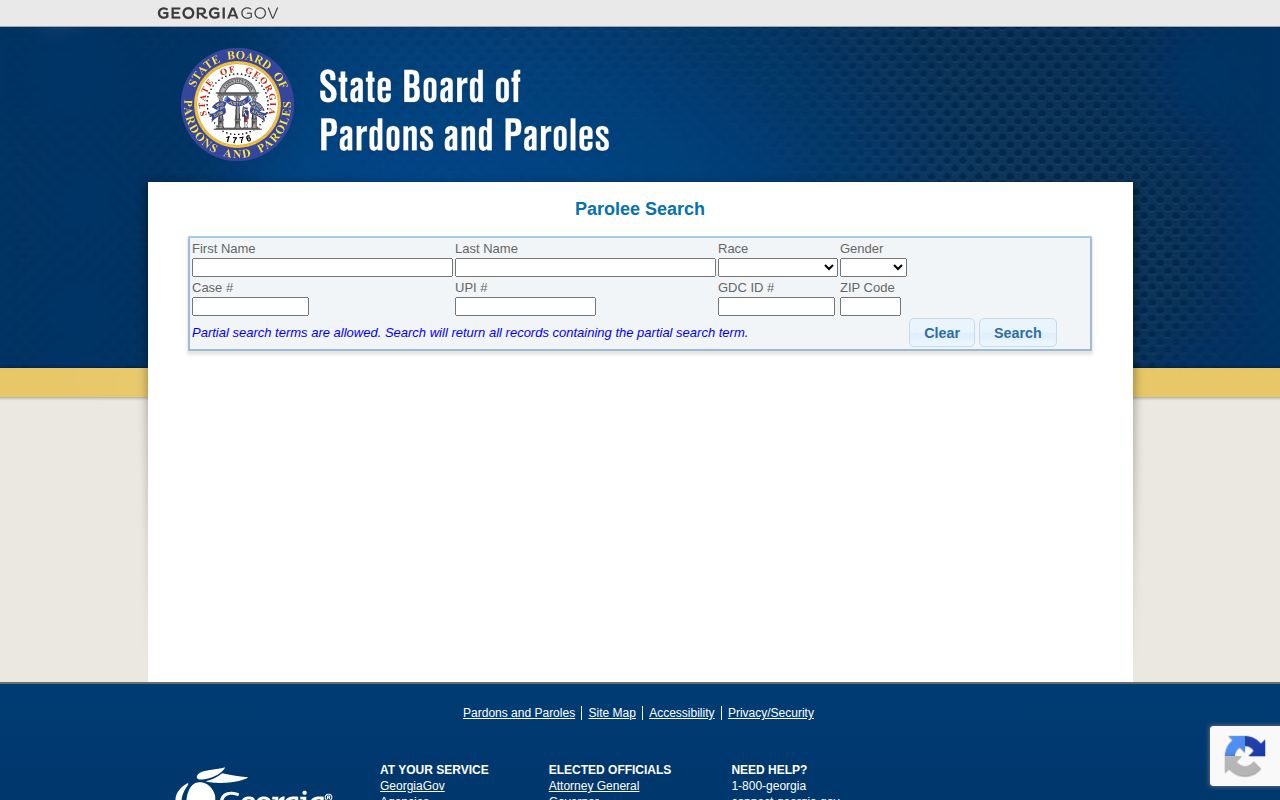
The search belongs to the Parole Board, while field supervision belongs to DCS.
Telfair Supervision Status Changes
Supervision conditions are the rules set by the court, Board, and supervising agency. They may involve reporting, travel approval, treatment, fees, or compliance with special terms in the sentence. The exact conditions belong to the person's order and supervision record. A public database summary cannot replace those documents.
A violation allegation does not always mean immediate return to custody. DCS may investigate, a court may address a probation matter, or the Board may act in a parole case. An absconder is a person alleged to have stopped reporting or left supervision without approval. Warrant status should be accepted only from the agency or court that issued it. No separate public Telfair absconder list was confirmed in the research.
When a person is taken into custody again, Georgia VINE may provide a custody-status change if the holding system participates. It still does not establish why supervision changed. Court dockets, DCS, and Board records provide the legal cause.
Telfair Supervision Discharge Records
Supervision ends through the authority that imposed or administers it. A parole record may carry a parole end date or later discharge status. A probation term is grounded in the court judgment, and the docket may show completion, early termination, revocation, or another final order. “Released” from jail and “discharged” from supervision are not the same event.
Georgia public records law generally favors access to existing records, subject to exemptions. An agency does not have to create a new report merely because a requester wants a custom supervision summary. Ask for an existing court order, parole result, or releasable DCS record with a clear name, case identifier, and date range. The Georgia Open Records Act overview explains the existing-record principle.
If the question is whether a term has ended, compare the parole end date or court term with any later order. Do not infer discharge from silence in a live roster. Older court and agency records often provide the durable proof.
Note: Completion of one supervision term does not resolve a separate case, hold, warrant, or sentence from another jurisdiction.
Correct Telfair Supervision Records
Telfair County contains a county jail and two active state-prison facilities, so the office that holds a disputed record matters. A booking or county release error should go to the Sheriff's Office or jail records custodian. A court disposition error belongs with the Telfair Clerk and the issuing court. GDC handles state-prison offender-record issues, while DCS handles questions about the supervision record it maintains.
Start with the exact entry, not a broad request to “fix the record.” Save the name shown, case or GDC number, date, source, and the conflicting official document. Ask which correction process applies. The GDC open-records route may supply an existing state record, while court orders must come from the court custodian.
This split is the distinctive local problem. A person can be released from a prison in Telfair County but supervised elsewhere based on the approved residence. Likewise, a person supervised in McRae-Helena may have been sentenced in another county. The record creator remains the best correction point.
Telfair Parole Decision Records
Georgia's public parole tools change with the stage of the case. Before release, the Board's inmate TPM lookup may show tentative timing. A Tentative Parole Month means the Board expects to finish a final review during that month and may then set a date. It is not a grant and not proof that release occurred.
After a claimed release, the parolee database is the stronger public check. Look for a parole begin date, end date, and a matching identity. “Granted,” “denied,” “deferred,” and “rescinded” describe different Board actions. A denial or deferral means the expected parole route did not produce release then. A rescission can explain why an earlier plan changed.
Georgia did not present an ordinary Telfair-specific public hearing calendar in the researched sources. Do not invent a monthly schedule. Case-based Board tools, the court sentence, and GDC status provide the sound path. Eligibility also depends on the offense and sentence. O.C.G.A. § 42-9-45 supplies a general parole-consideration rule, while O.C.G.A. § 17-10-6.1 imposes restrictions for serious violent felonies.
Telfair Release and Supervision Split
Telfair County's mix of facilities makes the first status check unusually important. A person leaving Telfair County Jail after bond may have no DCS supervision at all. Another person may leave after a felony probation sentence and report to DCS. Someone leaving Telfair State Prison or McRae Women's Facility on parole has a Board release decision plus a DCS supervision path. These records cannot be merged into one roster.
Start with the court sentence when custody began locally. It can distinguish bond, time served, probation, a split sentence, and commitment to GDC. Start with GDC and Board records when a state institution held the person. For historic federal custody at the former McRae prison, federal supervised release is a court and probation-office matter, not Georgia parole.
Physical release location also does not identify the supervising office. DCS assignment may follow the approved residence and case needs. The McRae-Helena listing is the right local routing point for Telfair service, but staff must confirm the actual assignment. Ask a narrow status question and avoid requesting private details that are not part of a public record.
A current-custody search and a supervision search answer separate questions. The first asks who holds the person now. The second asks whether a court or Board still imposes community rules. Confirm both when a transfer, warrant, or recent release makes the record unclear.